Adorable AI Puppies


Another collaboration with Nadine Scholtes! (Nadine and I have done an AI-themed cartoon once before).


I’m in my fifties, and therefore suspect myself anytime I don’t like a new technology. Is it really bad, or am I, in the manner of generations of older people before me, just hating the new tech because it is new? Is it just my inner Grampa Simpson coming out?

But man, they’re just shoving AI down our throats so hard!

There have been a few times when I’ve shared something adorable or funny only to find out that it’s an AI fake. Now I hesitate. I’ve become the person in this cartoon, except that I fortunately have a bit more chill. We can’t just enjoy that cute video of bunnies hopping on a trampoline; we have to investigate it for signs of being fake. (The bunny video, which got tens of millions of views, was AI-generated.)

And this effects how we watch real videos. Danqing Shi and co-authors, in a study published in Scientific Reports, wrote:

These findings have significant overarching implications – they suggest that our behavior changes not only when we engage with an AI-generated video, but as soon as we are aware that videos can be fake. With the increasing prevalence and growing awareness of AI-generated content, this is likely to change how people interact with the video medium altogether. While one can argue this is true for other generated content, videos have been, for years, considered one of the most reliable forms of evidence, underpinning critical societal processes from fair trials to democratic discourse. While it is well-known that generative AI endangers the reliability of evidence, our results highlight a secondary, perhaps more insidious risk: the mere possibility of AI fabrication already changes how we witness and interact with the world.

A paper on the MIT Media Lab website had similar findings; just knowing that videos might be AI changes how we view all videos, including real videos.

We conducted a two-phase study (𝑁 = 100), comparing participants first exposed to AI-generated videos to a control group viewing human-generated videos, before both groups transitioned to human-generated content. Despite clear disclosure, the AI-exposure group reported increased doubt about subsequent  videos’ authenticity, reduced judgment confidence, greater perceptual disruption, and lower social connectedness.

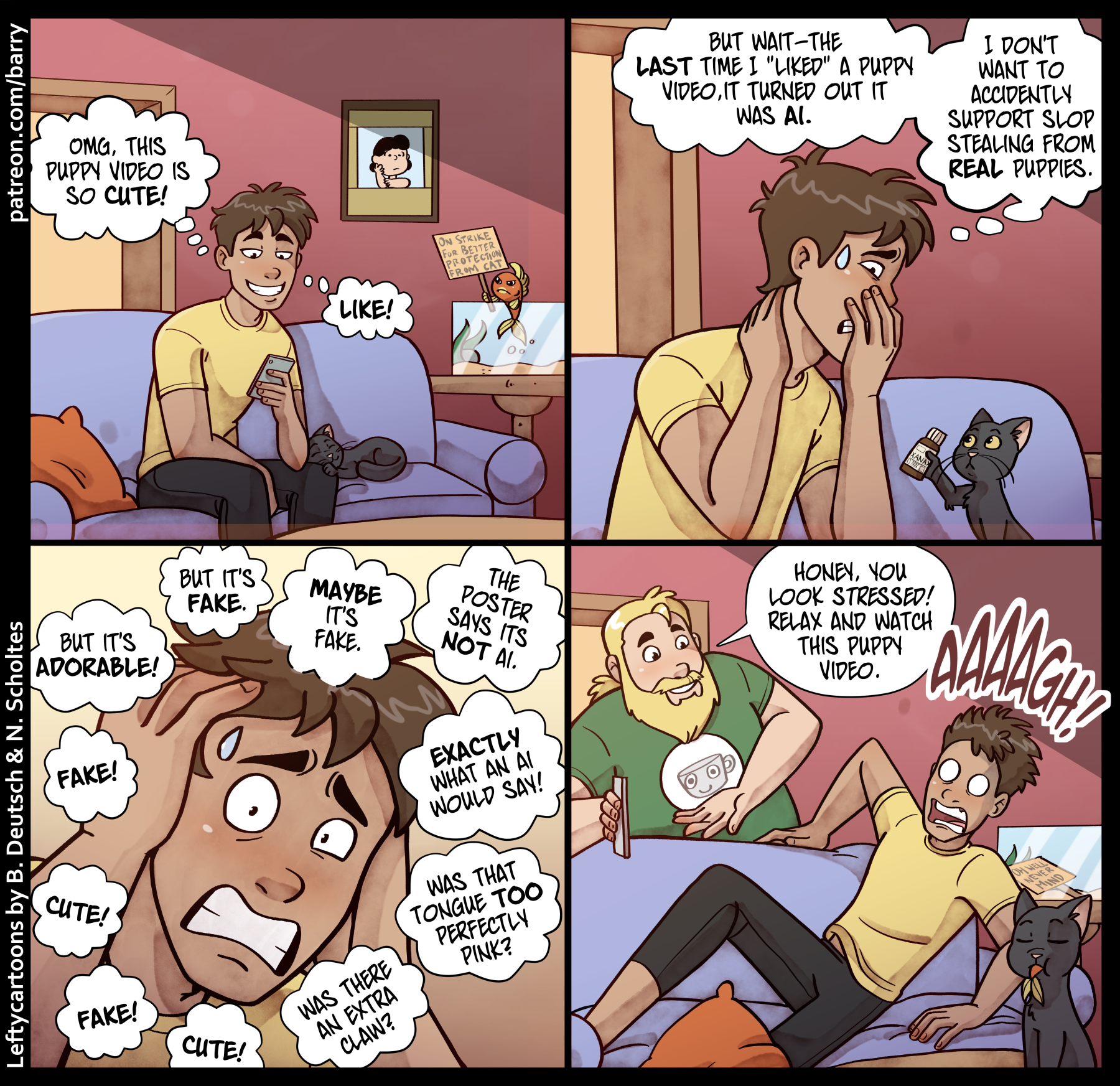
When I wrote this cartoon, I was intending to do a light, funny cartoon for once. Wacky faces! A character surrounded by his own thought balloon! But the reality behind this cartoon has some very dark implications.


I frequently encounter AI-suspicion from the opposite angle: It’s become routine for people to knowingly declare that our cartoons are obviously AI-generated. In particular, all the background gags — especially things that change from panel to panel, like t-shirts or graffiti — are proof that we don’t draw these ourselves. When I tell them our cartoons are drawn by humans, they sometimes believe me. Sometimes.


TRANSCRIPT OF CARTOON

PANEL 1

A young man sits on a couch, smiling at a video on his phone. A black cat sleeps beside him.

MAN (thinking): OMG, this puppy video is so cute!

MAN (thinking): Like!

PANEL 2

The man suddenly looks anxious, one hand pressed to his face.

MAN (thinking): But wait—the last time I “liked” a puppy video, it turned out it was AI.

MAN (thinking): I don’t want to accidentally support slop stealing from real puppies.

Nearby, the black cat holds up a bottle of Xanax.

PANEL 3

Extreme close-up of the increasingly frantic man. Thought balloons circle around his head:

But it’s adorable!
Fake!
Cute!
But it’s fake.
Maybe it’s fake.
The poster says it’s not AI.
Exactly what an AI would say!
Was that tongue too perfectly pink?
Was there an extra claw?
Fake!
Cute!

PANEL 4

A bearded man approaches, holding out his phone for the first man to see. The first man recoils in horror.

BEARDED MAN: Honey, you look stressed! Relax and watch this puppy video.

MAN: AAAAAGH!

CHICKEN FAT WATCH

In panel one, a goldfish is half out of its aquarium, picketing with a sign reading, ON STRIKE FOR BETTER PROTECTION FROM CAT. A framed portrait of Lucy from Peanuts is on the wall.

In panel two, the cat offers the stressed man a bottle labeled XANAX.

In the final panel, the goldfish’s abandoned sign now reads, OH WELL NEVER MIND. The black cat is contentedly eating the goldfish.


Adorable AI Puppies | Barry Deutsch on Patreon

Posted in Cartooning & comics | 14 Comments

Everyone Knows Elections Are Rigged


In June of 2026, Speaker of the House Mike Johnson was asked by CNN what evidence there is to prove election fraud in California:

JOHNSON: It stinks to high heaven, and everybody knows that. Let’s remove the appearance of impropriety.

CNN: But what evidence is there to prove that the election was rigged?

JOHNSON: Some of these efforts are so diabolical and so far upstream, it is impossible to prove. But I think everybody knows instinctively something is wrong here, and that’s a concern. We need people to believe in the integrity of our election system.

Johnson went on to tout a voter ID law. But no allegedly anti-fraud legislation will solve the problem of eroding trust in our elections, because the cause of the distrust isn’t fraud. Fraud is incredibly rare in US elections. The distrust is caused by people like Mike Johnson spreading the lie that our elections are rife with cheating.

(But only when a Republican loses, of course.)

Johnson’s cavalier dismissal of the need for evidence is typical of powerful Republicans arguing for anti-voting laws. Senator John Kennedy, Republican of Louisiana, argued for the voter suppression “SAVE Act” by saying “The American people no longer have confidence in our elections. You can debate whether that’s justified or not, but it’s just a natural fact.”

The lack of confidence in elections isn’t a “natural fact” — it’s been carefully manufactured by Kennedy, Johnson, and other Republicans (Trump most of all). But what’s fascinating is how blithely Kennedy dismisses the question of whether the belief in rigged elections is actually justified.

A 2021 study in The Journal of Experimental Political Science examined the effects of “unsubstantiated claims of voter fraud.”

Our study provides new evidence demonstrating the corrosive effect of fraud claims like these on trust in the election system. Using a nationwide survey experiment conducted after the 2018 midterm elections – a time when many prominent Republicans also made unsubstantiated fraud claims – we show that exposure to claims of voter fraud reduces confidence in electoral integrity, though not support for democracy itself. The effects are concentrated among Republicans and Trump approvers. Worryingly, corrective messages from mainstream sources do not measurably reduce the damage these accusations inflict.

Philip Bump, writing in The Washington Post, came to similar conclusions:

The question, then, is why 6 in 10 Republicans think fraud is a major problem. Where does this objectively false belief originate? The answer is not hard to establish: Republican leaders have spent decades claiming that fraud is rampant, setting the framework for Trump to dramatically scale those claims upward after his 2020 loss. […] The result? A Republican electorate that fervently believes that illegal voting is a huge problem — and that democracy itself is failing.


I always like Frank Young’s colors, but I think his colors for this strip are particularly nice. I especially like his choice to make panel one a nighttime scene.


Drawing this one was a lot of work (because of the unusually perspective-heavy-for-me backgrounds in the first two panels, and because of all the chicken fat), but it was fun.

Panel one’s background is a simplified drawing of the convenience store next door to Refuge Coffeehouse, the cozy and friendly place where I draw my cartoons. Even with internet, occasionally the easiest way to find a visual reference is to get up and walk thirty feet.

In panel two, I initially drew the Republican dude shaking a closed fist, but Jenn Lee and Becky Hawkins, who were with me at Refuge that day, looked at my pencils and claimed that the fist-pumping resembled a gesture with different implications than what I was shooting for.

I still have no idea what they were on about.

—

Thanks so much, as always, for supporting these cartoons! I’m constantly amazed at my good fortune that y’all exist.

—

TRANSCRIPT OF CARTOON

This cartoon has four panels.

PANEL 1

On a city sidewalk, a balding man in a shirt and tie is talking insistently to a purple-haired passerby with glasses and tattoos.

MAN: Hey, pal, guess what? They’re letting millions of illegals into the country to vote for Democrats!

PANEL 2

In a kitchen, the same man has stuck his head and shoulders through a window into the kitchen, shaking a finger emphatically as he lectures a startled woman.

MAN: The Democrats’ dirty vote machine is so diabolical it’s impossible to “prove,” but everybody knows it stinks!

PANEL 3

In a park, the same man has grabbed another person by the shoulder and is shouting in their face.

MAN: Never mind “proof.” Your elections are stolen! It’s all rigged! Democracy is dead!!

PANEL 4

Close-up of a hand holding a phone. On the screen, the same man—now smiling and calm—is speaking on Fox News.

MAN: Of course there’s proof elections are crooked! Because if they aren’t, why do so many Americans think they are?

CHICKEN FAT WATCH

Panel 1: Graffiti on the wall says: “I have tagged this wall, and therefore I have become immortal”; “20 percent is the new 15 percent”; “Pore Jud is Daid”; “BG”; “BG yes again”; and “The Vanishing Point is the God of Us All.” Also on the wall, a purple cartoon bunny, labeled “Evil Bunny,” is surrounded by flying knives.

In the store window, ad posters include a cigarette brand called “DIE,” a cupcake with a happy worm crawling out of it, Beaker from the Muppets, and a column of comic-book sound effects: “Bim Bam Boom Boot Toot.”

A newspaper on the sidewalk is called the Background Tribune. The headline reads “Crucial Headline In Left Corner Cropped Off. Thousands of Deaths Blamed on a Cartoonist’s Laziness. ‘Whoops’ says the jerk.” The headline on the lower left is cut off by the panel border, but in my mind it was “Whomp Whomp.”

A bottle lying in the gutter is labeled “Hootch Juice.”

Panel 2: A cereal box is labeled, “Your Childhood Cereal You Keep Eating Even Though It’s Bad,” and promises the “Same Awful Taste!” On the side of the cereal box, it says “100% 90%” and then in small letters “are both numbers.”

In a coffee mug on the counter, a mouse wearing a purple hat sits thoughtfully.

On a shelf, cookbooks include Cook Book, Schnook Book, You Can Cook! and Just Kidding, You’re Awful! There’s also a glaring bald head with a cigar.

Panel 3: A notice nailed to a tree reads: “NOTICE: People who read tiny background text will be sent to bed with no supper. —Your Mom.” Nearby, the Evil Bunny from panel one is partly emerging from a hole in the ground, smoking a joint and holding a teddy bear. Woodstock from “Peanuts” is sitting on a tree branch.

Panel 4: The Fox News logo says “Nox Fews.” The news crawl says “Muffin Man: ‘No one knows the real me’” and “Single best celebrity dies. ‘Whoopsies’ says God.” (I wrote that one the day Dolly passed away.) Thumbnails for other stories are headlined “Global Warming: FAKE” and “If global warming isn’t fake then it’s GOOD NEWS!” with a picture of a smiling sun wearing sunglasses and enjoying the beach.


Everyone Knows Elections Are Rigged | Barry Deutsch on Patreon

Posted in Cartooning & comics, Elections and politics | 5 Comments

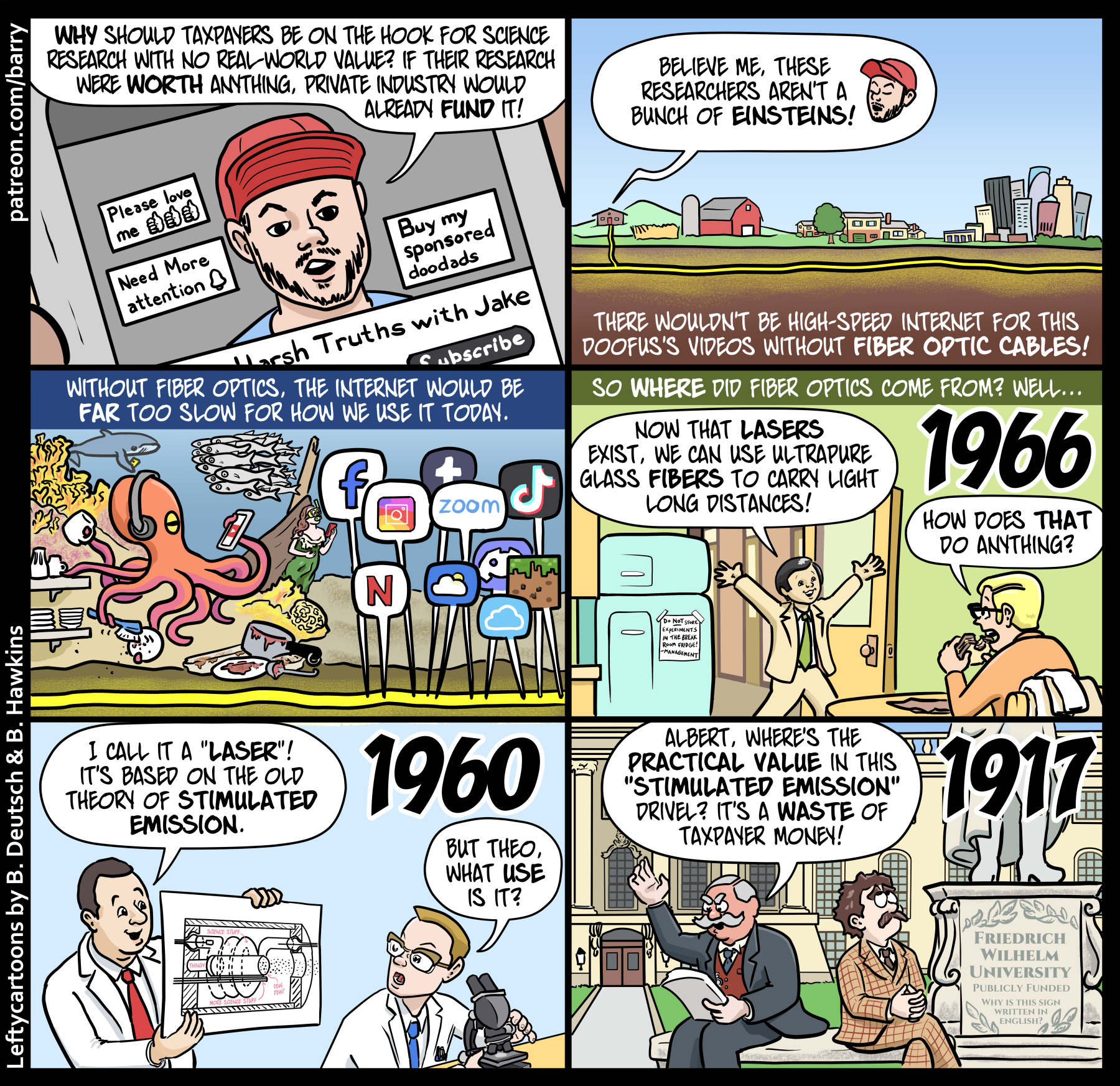
A Bunch of Einsteins


Another collaboration with Becky Hawkins!

Becky writes:

This cartoon was a fun mix of historical (Charles Kao! Theodore Maiman! Young Einstein at Friedrich Wilhelm University!) and fanciful (annnd the octopus is… watching YouTube! while doing dishes!).

Barry’s script for panel 2 says “A cross section of a buried cable – buried under city or farm or woods, whatever you like – and the dude’s word balloon is coming from the cable.” I sketched a cross-section of fiber optic cable with some dirt around it. I sketched another version from farther away, with a city and farm and suburbs, which Barry preferred. I like that this version shows how the internet connects different regions.

It was fun to draw the transition from mountains to farmland to suburb to city. It’s the sort of progression you see driving back to Portland from the coast, or taking any intercity rail. Yes, I think about these things hard enough to draw brick warehouses and a tiny self-storage unit on the outskirts of the city. I’ve been known to get unnecessarily bogged down in a quest for accuracy (such as last June’s Pittsburgh skyline) so it was a fun departure to draw a deliberately cartoony Downtown, USA. I did look at LA and Houston for skyscraper inspiration.

After the drawing was done, I realized the word balloon in panel two could be coming from the cabin on the left instead of the cable itself. I like how that tells us something about Jake of the imaginary YouTube series, Harsh Truths with Jake.


Barry writes:

I’m still a bit in shock over the huge cuts to basic research. Supporting basic research shouldn’t be a matter of ideology; plain old greed should be enough. Funding basic research will, in the long run, make the US (and other countries) wealthier.

All our grandchildren — including the grandchildren of the Republicans themselves! — are being made poorer by defunding basic science.

I considered a lot of examples of publicly funded science producing economic value: quantum mechanics and semiconductors; DARPA leading to the internet; the global positioning system; CRISPR gene editing; messenger RNA (mRNA), which led to COVID vaccines; the Human Genome Project.

Our world would look unimaginably different without the decades of public science funding underlying modern life.

After considering a bunch of options, I ended up writing a cartoon about lasers. There were a few reasons, but a major one was that I could hook Einstein into it, giving me a chance to do the “they’re no Einsteins” gag.

Lasers are used for a lot more than just fiber optics (although just that would be pretty fantastic). Barcode scanners, eye surgery, DVD players, industrial precision cutting, and of course hypnotizing cats are just a few of the ways we use lasers. (Wow, does this paragraph sound like an extremely boring film I might have been forced to watch in the second grade.)

When lasers were first invented, Charles Townes called them “a solution in search of a problem,” and it’s such a great quote that it’s a shame there’s no evidence that Townes ever said it. People really did say that about lasers in the 1960s, but we just don’t know who said it first.


TRANSCRIPT OF CARTOON

This cartoon has six panels.

PANEL 1

A bearded man in a red cap is recording a video of himself.

JAKE: Why should taxpayers be on the hook for science research with no real-world value? If their research were worth anything, private industry would already fund it!

PANEL 2

Jake’s rant continues over a cross-section of the landscape, from farmland and suburbs to a city; his voice is coming from a little cabin. A fiber-optic cable runs underground all the way across the panel.

JAKE: Believe me, these researchers aren’t a bunch of Einsteins!

CAPTION: There wouldn’t be high-speed internet for this doofus’s videos without fiber optic cables!

PANEL 3

Under the ocean, a fiber-optic cable runs along the ocean floor. Word balloons coming from the fiber optic cable contain the icons of many internet-based services — Facebook, Zoom, Discord, Netflix, Minecraft, and more.

CAPTION: Without fiber optics, the internet would be far too slow for how we use it today.

PANEL 4

CAPTION: So where did fiber optics come from? Well…

CAPTION: 1966

In a laboratory break room, an excited scientist throws his arms wide while another scientist eats at a table.

SCIENTIST: Now that lasers exist, we can use ultrapure glass fibers to carry light long distances!

OTHER SCIENTIST: How does that do anything?

PANEL 5

CAPTION: 1960

A scientist proudly holds up a diagram of a newly invented device. Another scientist sits at a microscope.

SCIENTIST: I call it a “laser”! It’s based on the old theory of stimulated emission.

OTHER SCIENTIST: But Theo, what use is it?

PANEL 6

CAPTION: 1917

Outside a university, a pompous-looking man gestures indignantly as he reads a scientific paper. He’s speaking to a young Albert Einstein, who rolls his eyes.

MAN: Albert, where’s the practical value in this “stimulated emission” drivel? It’s a waste of taxpayer money!

CHICKEN FAT WATCH

In panel 1, Jake’s video is titled “Harsh Truths with Jake.” Signs behind him read “Please love me” with three thumbs-up symbols, “Need More attention” with a notification-bell symbol, and “Buy my sponsored doodads.”

In panel 3, the octopus is simultaneously listening to headphones, drinking coffee, using a phone, and washing dishes. A whale with swims overhead, looking at her phone. A shipwreck has a figurehead wearing a snorkel and looking at a phone.

In panel 4, a note taped to the refrigerator reads: “Do NOT store experiments in the break room fridge! —Management.”

In panel 5, the technical diagram has parts labeled “SCIENCE STUFF,” “THINGY,” “MORE SCIENCE STUFF,” and “PEW! PEW!”

In panel 6, the statue pedestal reads: “Friedrich Wilhelm University. Publicly Funded. Why Is This Sign Written in English?”


A Bunch of Einsteins | Barry Deutsch on Patreon

Posted in Cartooning & comics, Economics and the like, science | 10 Comments

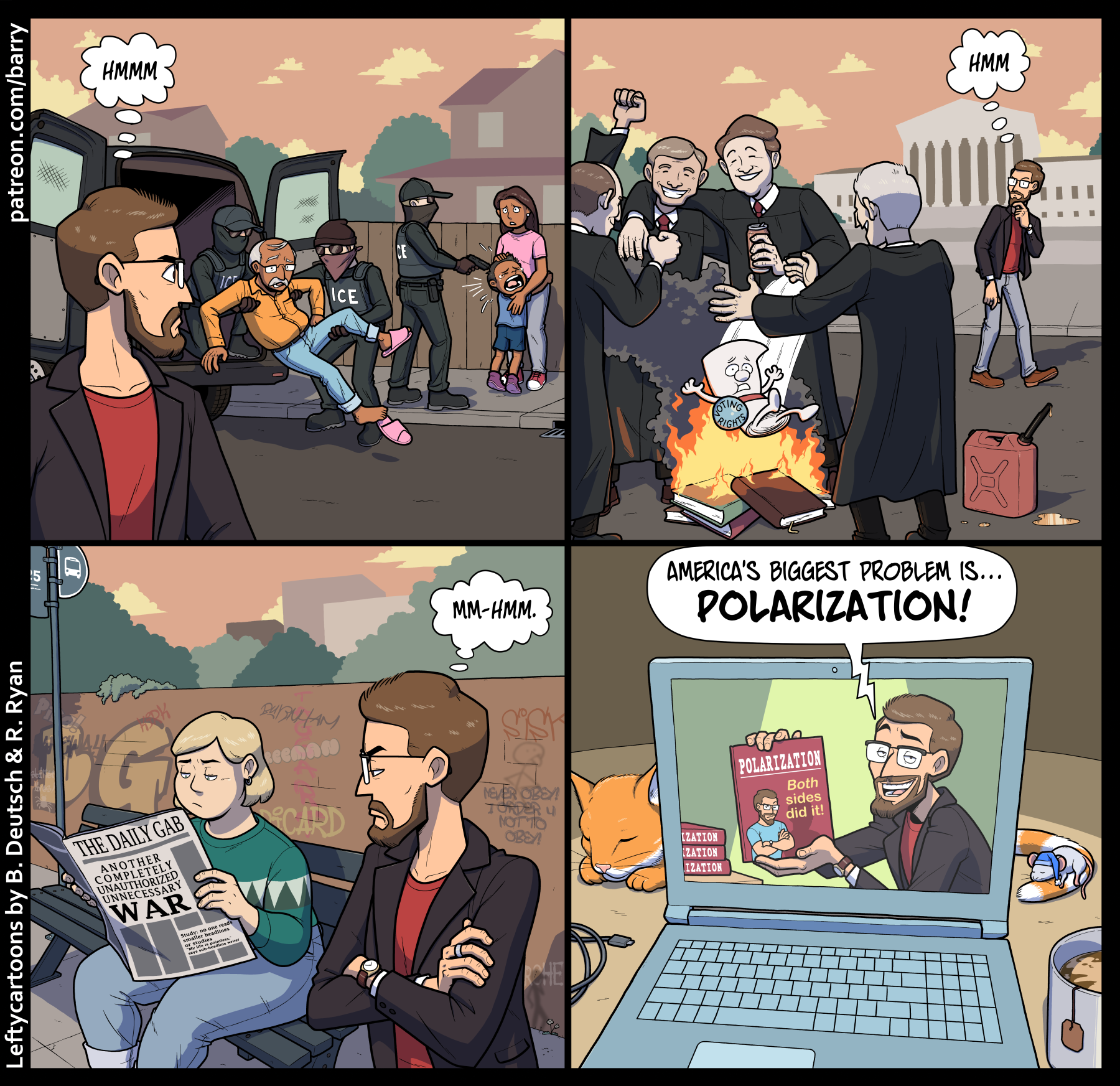
America’s Biggest Problem


Another collaboration with gorgeous visuals from R.E. Ryan.


University of Amsterdam professor Petter Törnberg wrote an article that could have been written to go with this cartoon: It’s Not Polarization; It’s the Radicalization of the Political Right.

Polarization offers an ostensibly neutral frame, distributing blame evenly across the political spectrum. Much like journalism’s “both-sides” logic, its scholarly embrace allows analysts to diagnose dysfunction without appearing partisan. […]

Yet this neutrality is not borne out by the empirical evidence. Across advanced democracies, crisis is resulting not from mutual divergence but from the one-sided transformation of the political right: the mainstreaming of authoritarian rhetoric, the normalization of conspiracy and hate as political strategies, and the systematic dismantling of institutional guardrails. […]

Refusing to name asymmetry is itself a political act. To continue describing democratic crisis as polarization is to lend legitimacy to those undermining democracy by treating them as one half of a symmetric dynamic. Neutrality under these conditions is not objectivity: it is complicity.

Törnberg’s article is about scholars, whereas my cartoon is about journalists and pundits, but the same analysis applies. A certain kind of personality likes finding a way to blame both sides no matter what the conflict is. It lets them — or “us,” I should say, since my personality definitely includes this flaw — feel like our analysis is smarter, our viewpoint fairer, and our insights deeper.

And yet, so many of the stupidest ideas I’ve heard have come from people who proudly declare themselves above taking sides.

To quote Thomas Zimmer (as I’ll do a lot in this post):

The “polarization” concept is useful if you want to sound serious by lamenting the state of American politics but don’t understand or deliberately want to obscure the fact that the major threat to democracy is a radicalizing Right.

It’s certainly good to be able to criticize both parties. But viewing everything through a polarization lens can be as distorting as viewing everything through a partisan lens.

Commenting on Ezra Klein’s Why We’re Polarized, Thomas Zimmer points out that Klein, in the final section of his book, admits that it’s the Republicans who have changed — but still attempts to cling to “polarization.”

To account for these rather crucial differences between Left and Right, Klein employs the concept of “asymmetrical polarization.” But that doesn’t really solve the problem. Even when it comes with the qualifier “asymmetric,” the term “polarization” still implies both sides moving towards the extremes at least to a somewhat significant degree – and that is certainly how the term is used in the broader public discourse and understood in widely accepted parlance today. But based on the evidence Ezra Klein himself presents, there is no liberal version of Fox News and the rightwing media bubble, the Democrats don’t have a Trump, and there is no equivalent on the Left to the influence of reactionary and white nationalist forces inside the GOP. If, by the authors’ own standards, de-emphasizing the concept of “asymmetric polarization” and instead foregrounding the idea of a radicalization of the conservative movement and the GOP would capture the central development in recent U.S. history and politics more adequately and precisely, why doesn’t he?

From what I’ve seen, Klein is the best of the “polarization is the problem” pundits, but that’s perhaps not the highest bar to clear.

And as Zimmer said on Bluesky, it’s no surprise that the “polarization” analysis has been seized upon by conservatives, who recognize the value to their cause of prioritizing the “value” of depolarization over values like democracy and anti-bigotry.


TRANSCRIPT OF CARTOON

This cartoon has four panels. The same bespectacled, bearded man appears in all four.

PANEL 1

The man walks past several masked ICE agents. Two agents are dragging an older man toward the open back of an SUV. Nearby, a distressed woman stands with a small child who is crying. An ICE agent is pointing a gun at the child.

MAN (thought): Hmmm.

PANEL 2

Outside the Supreme Court, several Supreme Court justices in black robes are drinking and celebrating around a bonfire in which the Voting Rights Act is burning. The man walks past in the background, watching them.

MAN (thought): Hmm.

PANEL 3

At a bus stop, a woman is reading a newspaper. The man stands beside her, leaning slightly to read the front page. The newspaper’s main headline says: ANOTHER COMPLETELY UNAUTHORIZED UNNECESSARY WAR

MAN (thought): Mm-hmm.

PANEL 4

We see an open laptop. On its screen, the man is appearing on a TV interview show, grinning as he holds up a copy of his book, Polarization: Both Sides Did It!

MAN: America’s biggest problem is… POLARIZATION!

CHICKEN FAT WATCH

In panel 2, the burning Voting Rights Act is depicted as the “I’m Just a Bill” character from Schoolhouse Rock!

In panel 3, the newspaper is called The Daily Gab. Under the enormous war headline is a much smaller headline: “Study: No one reads smaller headlines or studies.” A sub-headline says “‘My life is pointless,’ says sub-headline writer.”

On the wall in panel 3, graffiti includes tags from all eight captains from Star Trek shows (Pike, Kirk, Janeway, Burnham, Freeman, Picard, Sisko, and Archer) plus Taggart from Galaxy Quest. Other graffiti includes “Skitter Lives!” with a spider; a huge “BG,” for “background”; and “Never obey! I order U not to obey!” It only occurs to me now, writing this transcript, that I should have made it “not 2 obey.” Oh well.

In panel 4, behind the laptop, a large orange cat is sleeping. Curled up asleep on the cat’s tail is a tiny mouse wearing a sleeping cap.


America’s Biggest Problem | Barry Deutsch on Patreon

Posted in Cartooning & comics, Media criticism | 39 Comments

Crime’s Gonna Get You!


Welcome back to Kevin Moore, whose lovely drawings we haven’t seen here in a pig’s age! (I have no idea what a “pig’s age” means.)


Did you know that, according to the FBI, homicide rates in the US are the lowest they’ve been since 1956? Well, probably you do know that — but you’re the sort of person who’d read my cartoons on purpose, so you’re weird. Most Americans think homicide rates have been increasing.

Americans have a vastly outsized idea of how common violent crime — and, in particular, murder — is. In 2019, Ipsos asked Americans to guess what percentage of deaths in the U.S. are caused by homicide. The average guess was 8.2%. (In reality, it’s 0.7%.)

If only we had an industry devoted to making sure that Americans are well-informed about matters of public interest. It would have to be an industry other than the news industry. In 2024, Pew published a report on “The link between local news coverage and Americans’ perceptions of crime.”

There’s a clear relationship between how much local crime news Americans consume and how concerned they are about their safety. Among Americans who get local crime news often, 33% are extremely or very concerned about local crime affecting them or their family. That figure falls to 19% among those who get local news crime sometimes and 10% among those who get it rarely or never.

As Pew points out, this might be because local news tells viewers that they’re in danger (as this cartoon suggests). Or it might be that people who are already convinced that crime is omnipresent seek out crime news to confirm their views. Maybe both are true, in a vicious cycle. But there’s no way to look at this and think the news media is doing a good job informing people about crime.

Violent attacks by strangers are especially likely to be reported by the media. in 1998, a study in the American Journal of Public Health found that “some homicides are more newsworthy than others.”

Even when multiple variables were taken into account, some homicides (those with female, child, or elderly victims; those in which the suspect was a stranger to the victim; those in wealthier neighborhoods) received more coverage and others (those with Black or Hispanic victims or victims with less than a high school education; those committed with nonfirearm weapons; those in which the suspect was an intimate of the victim) received less coverage than expected.

Seniors are particularly likely to fear violent crime – even though they’re less likely to be victims of violent crime. (Seniors are also particularly likely to watch local news, but remember about correlations and causation.)

It’s pretty easy to understand why the news media is like this – it makes them money. Political scientists Franklin Gilliam Jr. and Shanto Iyengar describe the dynamic:

The drive for audience ratings pushes local news organizations to favor an ‘action news’ format. Stories about crime provide the necessary ingredients for successful marketing of newscasts – a focus on concrete events, their impact on ordinary people, drama and emotion, and, above all, attention-getting visuals.

What’s much harder than seeing the problem, unfortunately, is imagining a solution to this. News in the U.S. is almost always made for profit; news producers are under enormous pressure to attract large audiences. In this context, there’s very little incentive for new outlets to tell audiences that we have less reason to fear crime.


TRANSCRIPT OF CARTOON

This cartoon has four panels. They all show the same scene: A woman in an orange tracksuit, in a park, is talking to a red robot on tank treads. The robot has a television screen for a head, with a newsman’s face on the screen, and “NEWSBOT-5000” written on its side.

PANEL 1

The woman walks peacefully along the sidewalk. The newsbot extends a microphone toward her. The newsman on its screen looks extremely cheerful.

NEWSBOT: Hi! It’s me, the media! Have you noticed that you’re surrounded by CRIME?

WOMAN: I am?

PANEL 2

A closer shot. The woman looks increasingly nervous, touching a finger to her cheek. The newsbot leans eagerly toward her.

NEWSBOT: Yes! You’re VERY endangered! It’s VERY likely that someone is about to jump out and murder you RIGHT NOW!

PANEL 3

The woman looks around a bit nervously, but all is quiet. The newsbot watches her with a worried expression.

PANEL 4

The newsbot suddenly yells at the woman. Startled, she leaps into the air, her glasses flying off her face.

NEWSBOT: ANY SECOND NOW!

WOMAN: AAUGH!

CHICKEN FAT WATCH

“Chicken fat” is an ancient cartooning term for fun but unimportant details in the art.

Panel 1 – The sun has a face and is smoking a cig. A tree also has a rather angry-looking face. A strange one-eyed creature—who Kevin assures me is not a minion, but a little creature that he’s been doodling his whole life—pops out of the ground. And a hostile raccoon accosts a frightened rat.

Panel 3 – The one-eyed creature is now up a tree. The tree’s face now looks like the tree is napping, including some drool. The rat is offering a bottle of booze to the raccoon.

Panel 4 – The tree’s face is now awake, surprised by the Newsbot’s yelling. The one-eyed creature is all the way on the horizon. And the raccoon and rat are happily drunk together.


Crime’s Gonna Get You! | Barry Deutsch on Patreon

Posted in Cartooning & comics, Media criticism | 12 Comments

Recycling


Another collab with Becky Hawkins! Becky and I are both fond of creating these history cartoons. Not every cartoon in the “history” category at leftycartoons is drawn by Becky, but I suspect most of them are.

And Becky did a great job with this one. I especially like panel three’s backgrounds — and, as is often the way, some nice work ended up hidden under a word balloon.


Over thirty years ago, Dutch scholar Teun van Dijk wrote a lengthy article called “Discourse and the Denial of Racism.” Among other things, he discussed the frequent combining of “positive self-presentation and negative other-presentation” – put another way, “I’m not bigoted, but isn’t this thing a marginalized group supposedly does just awful?”

…Speakers follow a double strategy of positive self-presentation and negative other-presentation. It is within this latter strategy also that disclaimers, such as ‘I have nothing against Arabs, but . . .’ have their specific functions. … The denial often serves as the face-keeping move introducing a generally negative assertion, following the invariable but.

“Don’t conclude from the bigoted thing I’m about to say that I’m a bigot.”

The disclaimer isn’t separate from the prejudice. It’s the protective wrapping that allows the speaker to express prejudice while preserving self-image. The persecuted group changes, but the rhetorical structure doesn’t.

Today, I most often hear this formulation used as the packaging for prejudice against trans people and immigrants. But as far as I can tell, the same packaging is used to deliver prejudice against every marginalized group, for generations. This cartoon is only four panels long, but it could have easily been twenty panels long.

(But who’d want to read that? Just thinking about it depresses me.)


TRANSCRIPT OF CARTOON

This cartoon has four panels, each showing a different period of history.

PANEL 1

Present day. A close-up of a hand holding a smartphone. The phone’s screen shows a talk show called “The JAQ Off.” Large letters on the front of the desk say “JUST ASKING QUESTIONS.” The host is interviewing a blonde woman in a red dress.

BLONDE: I don’t hate transgenders — I’m just against radical gender ideology.

PANEL 2

The 2000s. Two thin women are talking in the plus-size exercise-clothing section of a store. There are two fat mannequins dressed in exercise clothes, and a sign on the wall announces a sale on XL exercise clothes.

WOMAN: I’ve got nothing against fat people! But I hate it when they glorify obesity.

PANEL 3

Three white people dressed in 1940s clothing stand on a lawn, holding protest signs. The man in the center is speaking.

MAN: I have dear friends who are Jews! But the INTERNATIONAL JEWISH CABAL will destroy America!

The woman’s sign says: I DID NOT RAISE MY BOY TO DIE FOR UNCLE SHYLOCK

The man’s sign says: HITLER HAS NOT ATTACKED US. WHY ATTACK HITLER?

The third protester’s sign says: AMERICA FOR AMERICANS*

PANEL 4

A man in nineteenth-century clothing, wearing a huge stovepipe hat and a long blue coat, strides down a street while confronting a startled woman in an enormous hoop skirt. He carries a large sign.

TOP HAT: Understand I bear no ill will for the GOOD Catholics. But I abhor papist Romanist conspiracies!

CAPTION AT BOTTOM OF STRIP: RECYCLING.

CHICKEN FAT WATCH

“Chicken fat” is obscure cartoonists’ lingo for obscure details hidden in the art.

In panel one, the news chyron says “STUDY: EVERYONE IS JUDGING YOU.” Smaller print underneath says, “‘Shouldn’t You Be Working Now?’ asks Handsome Chyron Writer.” The recommended videos are titled “Hate is love,” “Vegan TERRORIST,” “This puppy hates libs,” and “Clickbaiters HATE this.”

In panel two, a poster headed “INSPIRE” continues, “…you to spend more money.” A warning sign says, “CAUTION: Pulling large pants size from bottom of pile may result in injury.” A poster showing a jogger and a dog in front of a beautiful lake scene says, “This could be YOU! …if you buy the right PANTS.”

In panel three, a poster in a store window says “DOCTORS LOVE SMOKING.” The “America For Americans” sign has a small print disclaimer: “*The white Protestant ones.”

In panel four, the horse is looking with alarm at the racist “IRISH MENACE” sign. The “Know Nothing Party” sign says in small print “*Most on-the-nose name ever.” There is a pig in a pinstriped waistcoat holding a pocket watch. A terrified-looking kitten is clinging to the hoop skirt. And several piles of horse manure litter the street, but is that chicken fat or just period detail?


Recycling | Barry Deutsch on Patreon

Posted in Anti-Semitism, Cartooning & comics, Fat, fat and more fat, Transsexual and Transgender related issues | 3 Comments

The Art of Persuasion


I’m really happy with the art in this one, especially the first two panels. In fact, because I was having so much fun drawing that double-panel background, I forgot about the word balloons and wasted some time drawing distant houses that ended up completely covered.

I’m also feeling very smug about how nicely the color scheme came out. And I know — it’s possible that I’ll hate this art when I look at it again a few years from now. But heck, I might as well try to enjoy the good feelings while they last.

(Did you catch my use of an em dash? Obviously I must be an AI!)


Two things that are true:

1) It will be awful for trans people if the Republicans win the midterms.

2) It will be awful for trans people if Democrats become anti-trans rights, and we wind up with what the UK now has: Both major parties being anti-trans.

Too many centrist Democrats arguing 1) seemingly have a hard time acknowledging 2).

My issue isn’t that some centrists disagree with trans people who are saying they’ll refuse to vote for anti-trans Democrats. I personally disagree with that tactic; so do some trans people I’ve read (trans people don’t have a groupmind). Tactical disagreements happen. They’re inevitable.

But refusing to acknowledge that there’s a problem isn’t a tactical disagreement.

I’ve seen too many centrist Dems sneering with hatred at trans people who are angry and scared by seeing some prominent Dems taking up anti-trans arguments. But why shouldn’t trans people be angry about that?

“I know — all I have to do is tell frightened people who see Dem support for their rights starting to slip away that they’re Trump-supporting morons! THEN they’ll support Dems!” is not the persuasive argument that some centrist Dems apparently believe it to be.

The prospect of the Dems moving away from their commitment to trans rights — as some prominent centrist Democrats have advised — is genuinely terrifying to trans people. And it’s too easy for cis people to say “that’ll never happen” when it’s not our rights tumbling off a cliff.

It’s striking that too many cis centrists are saying, in effect, “why can’t angry trans people just put aside their emotions and fears and think of the greater good?” when they themselves are terrible at putting their emotions aside.


If you want to read more about this issue, I recommend Julia Serano’s essay “On Democrats Who Cave in Response to Anti-Trans Attack Ads,” with the arch subtitle “and more importantly: a response to all the cis people responding to the way that trans people are responding to said Democrats’ responses.”

If you think your favorite candidate enacted the correct political strategy, then there is no reason to berate trans people for protesting it, as those protests should already be baked into your candidate’s calculations. So why are you berating trans people then? (Unless, of course, you enjoy berating trans people just for the sake of it.)

Alternatively, if you think trans people are capable of tanking your favorite candidate via our criticisms and protests, doesn’t that imply that your candidate (and their consultants and strategists) totally fucked up in their political calculations here? And if they did fuck up, shouldn’t you be reaching out and complaining to them (rather than berating trans people), in the hope that they might reverse their bad decision?

In other words, why are we blaming trans people for a decision that was made by cisgender politicians, consultants, and strategists?


TRANSCRIPT

Panel 1:
A woman and a man sit on a low stone wall in a park. The woman is upset; the man listens.

WOMAN: And now the Democrat in the race is backing some anti-trans laws! I’m not sure I can vote for that.

MAN (thinking): Uh-oh. Democrats need every vote. How can I convince her to vote for the Democrat anyway?

Panel 2:
The woman and man walk through the park, the woman ahead of him.

WOMAN: Of course, the Republican is even worse. But if Democrats turn against trans people… I’m so frightened.

MAN (thinking): I’ve got to be empathetic and persuasive.

Panel 3:
Close-up of the man, looking thoughtful with his hand on his chin.

WOMAN (off-panel): Look at what happened to the UK — they’ve now got two anti-trans parties. If we let that happen here, trans rights are dead.

MAN (thinking): Okay, I think I know how to reassure her and get her vote.

Panel 4:
The man is suddenly furious, leaning toward the startled woman and pointing at her.

MAN: You’re a Trump supporting moron and you deserve to die!

CHICKEN FAT WATCH

PANEL 1:
A good dog with a halo peers out a window. A hand sticks out of a hole in a tree holding a sign that says SEND CANDY.

PANEL 2:
Groucho peeks from behind some bushes. A poster nailed to a tree reads “Background gag to come and it’ll be so funny!” A bad rabbit (we know it’s bad because it’s smoking) sits beside a bad worm (also smoking). A bottle lying in the grass is labeled “BARRY BEER” and has a disturbed-looking drawing of Barry. A mouse holds a knife to a cat; the cat raises its front paws in surrender.

PANEL 4:
A giant mouse (?) in a shirt and tie sits on the wall reading a newspaper, called “Daily Blah Blah,” whose headline says “Literate Rodent Escapes Lab.”


The Art of Persuasion | Barry Deutsch on Patreon


Posted in Cartooning & comics, Elections and politics, Lesbian, Gay, Bi, Trans and Queer issues, Transsexual and Transgender related issues | 6 Comments

The Basic Barrier


Another collaboration with the chicken-fat-mad Mike Lawrence! That trap-filled hopscotch board was entirely Mike’s idea.


This is something I’ve suspected for a while—that the core reason many liberals don’t support a universal basic income (UBI) is that it just sounds too wonderful to happen. Especially when many of us have been conditioned, over the past decade or so, to expect nothing but the worst.

It turns out I’m not the first to have this thought (although I wonder if I’m the first to do a cartoon about it). In 2017, Alyssa Battistoni wrote:

The problem isn’t that basic income doesn’t sound good enough—it’s that it sounds too good to be true.

But James Surowiecki, writing in 2016 in The New Yorker, pointed out that utopian ideas sometimes surprise us by becoming mundane:

The most popular social-welfare programs in the U.S. all seemed utopian at first. Until the nineteen-twenties, no state in the union offered any kind of old-age pension; by 1935, we had Social Security. Guaranteed health care for seniors was attacked as unworkable and socialist; now Medicare is uncontroversial… It’s easy to imagine a basic income going overnight from completely improbable to totally necessary.


If you’re interested in the research on giving people money, a good overview is “A Summary of Existing Research on Guaranteed Income,” published by the University of Chicago Inclusive Economy Lab. The section on employment effects is on pages five and six. Generally, studies find “that cash transfers had either no effect or a positive effect on adult labor force participation,” although one study found a 2 percent-point decrease in labor market participation and a five percent decrease in earned income.


TRANSCRIPT OF CARTOON

This cartoon has four panels. Each panel shows two friends walking through a wooded park. One is a man wearing a baseball cap and an orange T-shirt, so I’ll call him ORANGE. The other is a woman wearing a red plaid shirt, so I’ll call her PLAID.

PANEL 1

Orange smiles as he reads something on his smartphone. Plaid looks interested.

ORANGE: Look at this! Another study found that basic income works!

PLAID: What’s basic income?

PANEL 2

Orange explains while Plaid hops through a hopscotch grid drawn on the path.

ORANGE: It’s the government giving everyone a basic income, so we’re all guaranteed enough to live on.

PLAID: That sounds amazing. But… if we had that, why would anyone work?

PANEL 3

Orange gestures emphatically with his free hand. Plaid walks with one hand thoughtfully against her chin.

ORANGE: That’s been studied so much… Over and over, when people are given basic incomes, they don’t stop working!

PLAID: Hmm… I’m still against it.

PANEL 4

Orange looks baffled. Plaid shrugs.

ORANGE: But why?

PLAID: I just can’t believe anything that good is possible.

CHICKEN FAT WATCH

“Chicken fat” is an obsolete cartoonists’ term for unimportant but fun details slipped into the art.

PANEL 1: A little gray alien is flying a flying-saucer-shaped kite.

PANEL 2: The hopscotch grid is full of traps, including a spider, tacks, a Lego brick, a mouse frantically waving its arms as if to say “Don’t step on me!,” a pile of poop, a whoopee cushion, a mousetrap, and a bear trap. A “wanted” poster for a raccoon with an eyepatch is nailed to a tree.

PANEL 3: A sasquatch and an Ewok are hiding behind trees; the sasquatch signals to the Ewok to be quiet.

PANEL 4: The raccoon from Panel 2’s “wanted” poster is hiding in the bushes.

CLOTHES: Orange’s T-shirt shows a smiley face in Panel 1, an alien smiley in Panel 2, the blood-spattered Watchmen smiley in Panel 3, and the Hitchhiker’s Guide smiley-faced planet in Panel 4.

Plaid’s T-shirt shows an ear of corn in Panel 2 and a human ear in Panel 4.

Orange’s cap has a picture of a fly (insect) in panel 1, and a picture of a fly (pants) in panel 2.


The Basic Barrier | Barry Deutsch on Patreon

Posted in Cartooning & comics, Economics and the like | 10 Comments

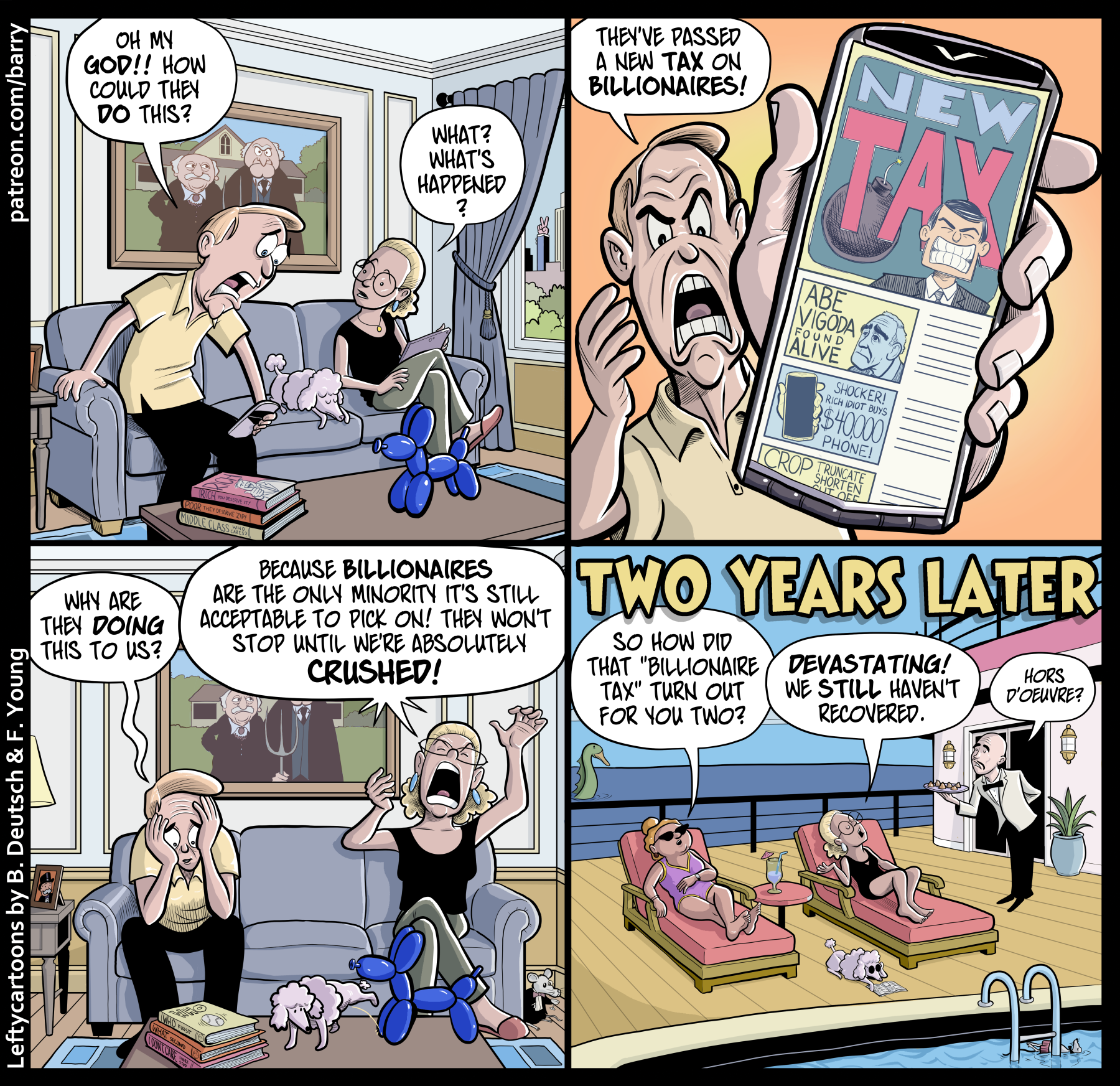
Those Poor, Poor Billionaires


Drawing the “Muppet Gothic” in the background was so much fun!


It’s funny when the extremist rhetoric I make up for my caricatures of rich right-wingers is less extreme than what some real billionaires say. In 2014, billionaire Tom Perkins wrote a letter to the Wall Street Journal:

I would call attention to the parallels of Nazi Germany to its war on its ‘one percent,’ namely its Jews, to the progressive war on the American one percent, namely the ‘rich.’ …Kristallnacht was unthinkable in 1930; is its descendent ‘progressive’ radicalism unthinkable now?”

Billionaire Sam Zell rushed to defend Perkins, adding: “The 1 percent are being pummeled because it’s politically convenient to do so.”

Billionaire Leon Cooperman, reacting to Elizabeth Warren’s proposed wealth tax, said “this is the fucking American dream she is shitting on.”

To be fair, not all billionaires are such bad people (although it’s bad that any exist at all). In 2024, over 250 million- and billionaires signed a letter called “Proud to Pay More,” calling for taxes on extreme wealth and saying such taxes would not change their standard of living.

We ask you to tax us, the very richest in society. This will not fundamentally alter our standard of living, nor deprive our children, nor harm our nations’ economic growth. But it will turn extreme and unproductive private wealth into an investment for our common democratic future.


TRANSCRIPT OF CARTOON

This cartoon has four panels. The first three show a wealthy, middle-aged couple in their luxurious living room with their poodle. I’ll call them MAN and WOMAN.

PANEL 1

The man leaps up from the sofa, staring with horror at his phone. The woman, sitting beside him, looks concerned.

MAN: Oh my God!! How could they do this?

WOMAN: What? What’s happened?

PANEL 2

A close-up of the anguished man holding his phone toward us. The phone displays a news page with the giant headline “NEW TAX.”

MAN: They’ve passed a new tax on billionaires!

PANEL 3

Back in the living room, the man sits hunched forward with his face in his hands. The woman throws her arms into the air, wailing.

MAN: Why are they doing this to us?

WOMAN: Because billionaires are the only minority it’s still acceptable to pick on! They won’t stop until we’re absolutely crushed!

PANEL 4

A large caption says “TWO YEARS LATER.”

The Woman from the first three panels is with a friend, relaxing in swimsuits on cushioned lounge chairs on a yacht, beside a swimming pool. A waiter approaches with a tray.

FRIEND: So how did that “billionaire tax” turn out for you two?

WOMAN: Devastating! We still haven’t recovered.

WAITER: Hors d’oeuvre?

CHICKEN FAT WATCH

“Chicken fat” is old-fashioned cartoonists’ slang for little unimportant but hopefully fun details in the art.

Panel 1: The painting on the wall is American Gothic, but with Statler and Waldorf from The Muppet Show. The coffee-table books are titled “RICH: YOU DESERVE IT!,” “POOR: THEY DESERVE ZIP!” and “MIDDLE CLASS: WHO CARES?” A poodle naps beside the couple, while a Koons balloon-dog sculpture is on the coffee table. Outside the window, a giant hand atop a building flashes a peace sign.

Panel 2: Other stories on the phone include “ABE VIGODA FOUND ALIVE,” “SHOCKER! RICH IDIOT BUYS $40,000 PHONE!” and (in a partially cropped off thumbnail) “CROP truncate shorten cut off.” The “$40,000 phone” image shows the same phone the man is holding up —and even the same hand. (And yes, that phone — the “Agent Q Himalaya Alligator Gold & Diamond” — is real.)

Panel 3: The coffee-table books now refer to Abbott and Costello’s “Who’s on First?” routine: “WHO — FIRST,” “WHAT — SECOND” and “DON’T CARE — SHORTSTOP.” A framed photo of the Monopoly Man sits on the end table. A rat in a tux holds a cocktail. The poodle pees on the Koons sculpture.

Panel 4: The poodle wears sunglasses and reads a magazine. The Loch Ness Monster (but with a duck head) swims in the ocean. The rat from panel 3, wearing swim trunks, is doing the back float in the pool.


Those Poor, Poor Billionaires | Barry Deutsch on Patreon

Posted in Cartooning & comics, Economics and the like | 17 Comments

Can We Call It Fascism Yet?


Another strip drawn by the amazing Mike Lawrence.


From an official press release on whitehouse.gov, July 16 2026:

Homeland Security Advisor Stephen Miller made clear there must be no retreat: “One of the hallmarks of left-wing violence and terrorism is its completely pre-textual and disingenuous appeal to civil liberties in an effort to shield its own violence… When the leftist — who does not believe in freedom, who does not believe in civil rights, who does not believe in any ordinary notion of justice — protests that we are violating his rights, understand the [sic] he is lying to try to persuade people who are not closely following the political scene that some injustice has perpetrated [sic] against him. We must stay the course and be completely unflinching in the pursuit of justice against these enemies of civilization.”

The rhetoric is unambiguously fascist. A typical fascist move is to describe their own community – however they conceive it – as the authentic national identity, and to then define out-groups or political opponents as existential threats to that nation. From there, it’s a short step to seeing state suppression of those groups as necessary for the nation to survive, and even to call that self-defense.

The extreme fascist rhetoric we’ve seen this month is, I suspect, the administration testing the waters to see if they have enough support to blatantly overturn the results of the midterm elections, which most people expect to go badly for Republicans. Heather Cox Richardson commented:

[Trump ally Stephen] Bannon argued in Tuesday’s War Room podcast that the idea of “communists” threatening to take over the United States through corrupt elections is “a predicate for immediate action.” That immediate action, he said, would be for Trump to declare “a national security emergency executive order…that took all of SAVE America plus plus plus plus.” And then, we can be sure, the Republicans will win the 2026 elections and, as Trump keeps saying, all the elections for the next 100 years.

I still think (or hope) this won’t happen – not because the Trump administration is above it, but because I think they’re shackled by Trump’s unpopularity. As Jim Stewartson points out, one key difference between Hitler and Trump is that Hitler was popular.


Incidentally, this strip was written and drawn well before that Trump Administration press release. Panel three’s original dialog referred to Trump’s plans for an “Election Integrity Army” for the 2026 election. But – as so often seems to happen with this administration – if you just wait a little while they’ll say something even worse.


TRANSCRIPT OF CARTOON

Panel 1

The year is 2024. A WOMAN and a MAN sit at a table in a coffee shop, looking at their phones.

WOMAN: The Supreme Court says no official act by the president can be a crime! Can we call it fascism yet?

MAN: Of course not. Don’t be hysterical.

Panel 2

The year is 2025. The WOMAN and MAN stand outside in snowy weather; the woman is pointing to something on her phone.

WOMAN: ICE invaded Minneapolis! Masked government agents are kidnapping people! Can we call it fascism now?

MAN: No! It’s bad, but let’s not exaggerate.

Panel 3

The year is 2026. The WOMAN and MAN sit on a park bench. She reads from her phone.

WOMAN: The White House says it’ll eradicate “Antifa militants” and ignore civil liberties. Can we call it fascism yet?

MAN: Enough with the doomerism!

Panel 4

The year is 2030. Armed, armored government troops stand nearby. The WOMAN begins to speak, but the frightened MAN stops her.

WOMAN: Can we—

MAN: Shhh! Do you want to get us arrested?

CHICKEN FAT WATCH

“Chicken fat” is an ancient cartooning term for fun but unimportant details in the art.

PANEL 1: The coffee shop is called “Bump & GRIND (not a strip club).” The menu offers “brewtentious latte, true brew, vessel w/ pestle, dragon flagon, palace chalice, hot tea” and in a section marked “Pies,” offers “whim pie, pup pie, gup pie, hip pie, and yup pie.” Groucho Marx’s decapitated head is in the pastry case. The extremely embarrassed-looking barista is reading a book called 5000 Shades of Gray. The coffee mugs have a logo consisting of the words “BAD LOGO” arranged around a pile of poop. A tentacle is reaching up from under the table to grab the pie.

PANEL 2: There’s a “Calvin and Hobbes” snowman in the background. The logo on his jacket says “pradagonia.” A bird in the tree is bundled up with a scarf and knit hat.

PANEL 3: Fozzie Bear peers out of a hollow in the tree. A groundhog emerges from a hole in the ground. The MAN’s boba tea appears to be filled with eyeballs. The man’s t-shirt says “REBEL ™”.

PANEL 4: Graffiti reads “Romanes Eunt Domus” and “We ♥ Leader.” There appears to be a shark swimming in the filthy water beside the sidewalk.


Can We Call It Fascism Yet? | Barry Deutsch on Patreon

Posted in Cartooning & comics, Conservative zaniness, right-wingers, etc. | 54 Comments